Saturday, May 7, 2011

Ride, Rosie, Ride: Napravnik first woman Kentucky Derby jockey since 2003

 "I don't think about first female to do this, first female to do that  ... I am proud of it, but it's not something I think about all the time."   -- Rosie Napravnik  
Rosie Napravnik courtesy of Mark Cornelison/McClatchy Tribune and the Detroit Free Press


    Out of a lineup of 20 riders in today's 137th Kentucky Derby, only one is a woman.

Anna "Rosie"  Napravnik, 23, will be the first woman to ride at Churchill Downs since 2003.  She will be riding Pants on Fire, who is owned by George and Lori Hall of Rumson, New Jersey.

Although there have been other women jockeys in the Kentucky, none has won the race.

Earlier in the year, Napravnik was the first woman to win the Louisiana Derby when she rode Pants on Fire to victory at the Louisiana Derby in March.  The Halls brought her back for the "run for the roses."

Modestly, Napravnik says, "I feel very lucky just to be here."

Other women Kentucky Derby competitors courtesy of the Detroit Free Press
So, the question is  "Why not more women jockeys?" in a sport where it  seems that men and women would be evenly matched in skill and ability?

Just a thought.

The race starts at 6:24 p.m. EST on NBC.


watch Rosie Napravnik and Pants on Fire win the Louisiana Derby:

Friday, May 6, 2011

Granholm & Mulhern set an example of modern gender roles

Jennifer Granholm and Dan Mulhern courtesy of TheMichiganinagurual on YouTube
Michigan's former first couple, Governor Jennifer Granholm and her husband Dan Mulhern, spoke with Detroit Free Press columnist Rochelle Riley about their changing family dynamics during Granholm's two terms as Michigan's first woman governor. 

Albeit not easy, they made it work by "keeping strict schedules, having date nights, ensuring that both attended all parent-teacher conferences" as well as going to church.

Could it really be that feminism is for everybody after all?

Mulhern told Riley:

" ... Having watched this blossoming of my wife in a time that couldn't have happened 20 years ago, I realize that for men, it really is our turn to figure that out.  So I hope to really play a role in that as a thought leader writer and speaker"

But there's more.


Mulhern also wrote a candid open letter to his son, Jack, in Newsweek magazine in response to the magazine's article "Dead Suit Walking ... can manhood survive the lost decade?" where he said this: 

"When your grandmothers were raised, being a woman meant being a housewife. But Mom and her generation seized new opportunities. As a prosecutor and attorney general, Mom developed extraordinary executive skills. I was proud, and learned to exult in her strengths. Her success freed me to see a man can be good—or great—without being a hero in war, sports, business, or politics. A strong man, Jack, is not threatened by others’ greatness. He’s comfortable with his own."

He continued:

"I have loved raising you and your college-age sisters. It’s been a gift. I stepped out of my male armor. I now cry when I’m sad, afraid, or just overwhelmed by the beauty of a sonata or a newborn baby. I don’t feel less of a man. I do feel more of a human being."

And finally ...

"If you lead like Mom, you’ll know how to persevere. You need not fear strong women, or dismiss gentle men. And if you so choose, you’ll be a great stay-at-home or lead parent, giving and receiving incredible lessons and profound joy. Either way, it’s a great time to be a man."

Yeah, he gets it. 
 
Read Rochelle Riley's interview with Granholm and Mulhern here. 
Also see Jennifer Granholm talks about gender politics.

Wednesday, May 4, 2011

"The Great Wall of Vagina:" A study of human individuality

One panel of "The Great Wall of Vagina"
 The big news out of England this week is not a royal wedding.  It's the debut of "The Great Wall of Vagina," at the Brighton Festival Fringe beginning on Friday, May 6.

The "Great Wall" is the work of plaster caster/artist Jamie McCartney.  McCartney owns Brighton Body Casting, a company/studio he opened to offer casting services to the public as a unique form of portraiture.  He also casts faces, torsos, etc.  in a variety of materials.

The project took five years and hundreds of volunteers -- about half from the Brighton area -- to complete.  Subjects included mothers and daughters, twins and transsexuals.  They youngest models were 18, the oldest was 76.

"The Great Wall of Vagina" in its entirety
The entire projects consists of 400 casts arranged into 40 panels.  In its entirety, the wall measures nine meters -- that's about 29.5 feet -- in length. 

On his website, McCarntey says the sculpture is " ... in no way pornographic, as it might have been if photographs had been used. One is able to stare without shame but in wonder and amazement at this exposé of human variety."

The vision, McCartney says," ... became clear to me whilst working on a not dissimilar piece for a sex museum that many women have anxiety about their genital appearance. It appalled me that our society has created yet one more way to make women feel bad about themselves. I decided that I was uniquely placed to do something about it. The sculpture comments on the trend for surgery to create the 'perfect' vagina. This modern day equivalent of female genital mutilation is a bizarre practice which suggests that one is better than another."

McCartney tried, unsuccessfully to find a victim of genital cutting to participate in the project.

"The more inclusive and complete I could be in this survey the more power this sculpture would have," McCartney said.

The Brighton Festival Fringe website describes the wall as "'The Vagina Monologues' of Sculpture."  The festival itself is is "one of the largest and fastest-growing open access arts festival in the world and the largest in England. It sets out to stimulate, educate and entertain a wide audience by providing a showcase for diverse art forms. No artistic judgment or selection criteria are imposed on participants, enabling the development of both new and established work to attract fresh audiences, press and promoters."

"The Great Wall of Vagina" will be on display until May 31.  It is rated as "suitable for ages 15+."

McCartney is in the beginning stages of marketing a do-it-yourself casting kits for vaginas as well as baby hands and feet, and adult hands.  The website promises a shopping cart system soon due to increased demand.  The kits include safe-for-the-skin alginate molding compound, casting plaster, mixing cup, brush, gloves and instructions all packaged in a bucket.

The "introductory price" for a vagina casting kit is the equivalent of approximately $64, plus shipping.

Artist Jamie McCartney talks about "The Great Wall of Vagina" and gives his favorite vagina euphemism:

Monday, May 2, 2011

A lesson in gendered language from the Associated Press Stylebook

In her book, "When Everything Changed:  The amazing journey of American women from 1960 to the present," journalist Gail Collins says, "One of the most energetic reeducation efforts of the 1970s involved teaching men not to automatically refer to a group of two or more women as 'girls' ..."

It might not seem so very important, but this was huge, because words mattered then and they still matter today.  Language is made all the more powerful through subtle connotations of words that perpetuate negative perceptions and stereotypes.

The Merriam-Webster Dictionary defines "girl" as "a female child."  The word "child" carries the connotation of immaturity -- that a female child, a girl, needs to be carefully supervised, coddled and rescued if she finds herself in a difficult situation.  And, of course, nobody really takes her seriously.

So, using the word "girl" when referring to a mature woman, is inappropriate, no matter how innocent or petty it might seem.

This is the stuff postmodern feminists, who realize the impact of language, attempt to root out through analysis and deconstruction.

Of course, there are occasions when the word "girl" is appropriate. 


Journalists look to the Associated Press Stylebook for guidance in current language usage.  Here are some AP style rules for gendered language that make sense to use in everyday writing and speech:

Girl:  "Applicable until 18th birthday is reached.  Use woman or young woman afterward." (The same rule applies to "boy" with "young man" afterward.)

Lady:  "Do not use as a synonym for women.  Lady may be used as a courtesy title or when a specific reference to fine manners is appropriate without patronizing overtones." (The same rule applies to gentleman.)

Women:  "Women should receive the same treatment as men in all areas of coverage.  Physical descriptions, sexists references, demeaning stereotypes and condescending phrases should not be used ... copy should not assume maleness when both sexes are involved (emphasis mine) ... Use the same standards for men and women in deciding whether to include specific mention of personal appearance or marital situation ...treatment of the sexes should be evenhanded and free of assumptions and stereotypes."

However, the book adds, "This does not mean that valid and acceptable words such as mankind or humanity cannot be used.  They are proper." 

And yet,

Man, mankind :  "Either may be used when both men and women are involved ... Frequently, the best choice is a substitute such as humanity, a person or an individual." (Emphasis mine.)

Female:  This is the preferred adjective, not woman. (The book does not make a comparable entry for "male.")

Sunday, May 1, 2011

Raquel Welch advocates sisterhood over girl-on-girl crime

I found this quote in today's Detroit Free Press and had to share it. 
Raquel Welch, 1972 courtesy of unrealitymag.com


Girl-on-girl crime is a frequent topic on this blog, because I feel it continues to hinder women's progress and success in society, politics and work as well as in their personal lives.

Sadly, it existed in the early women's movement and continues to perpetuate today.

Here, actress Raquel Welch , 71, tells popeater.com about feeling judged by the feminist movement in the early 1970s.  Her remark is valid:


"I guess at that time with the image I had I could understand it, but I didn't love the idea that women love to look down their noses at other women."

She extols the benefits of sisterhood and friendship:

Raquel Welch 2010 courtesy of unrealitymag.com
"I don't know what I would do without my women friends; the world would be a bleak place.  I think we should try and be a little more charitable to each other and try to be a little more understanding. It isn't a cakewalk to be born female, yet it can be so glorious, so entertaining, and so exciting."

Saturday, April 30, 2011

Poetry Podcast: Selections from "Hard Times Require Furious Dancing" by Alice Walker

"Her poems are medicine for the soul ." --  Artist Shiloh McCloud from the introduction to "Hard Times Require Furious Dancing"

Listen to the poems here:


Podcast Powered By Podbean


Alice Walker's name is almost synonymous with her best-known, Pulitzer Prize-winning novel "The Color Purple."  Yet, to define her solely as a novelist would be like defining light as simply white.  When viewed through a prism, many colors are revealed.   To view Walker through a prism is to see not only a novelist, but a "poet, short story writer ... essayist, anthologist, teacher and womanist activist,"  according to her official biography.
Alice Walker

Walker has directed the focus to the poetry band of her spectrum with her latest collection of poems titled "Hard Times Require Furious Dancing," published in October 2010. The poems were written over the course of one year and are an array of responses to joy and sorrow from a personal to a global level.

It is an example of how the act of writing poetry can be both cathartic and therapeutic and has been used by women as a vehicle for expression of their unique voices for centuries.

Walker describes herself as a "womanist."  It's a term she created that shakes up the definition of feminism and opens up a new, broader perspective.

In her paper titled, "Defining Black Feminist Thought," Patricia Hill Collins says, "Alice Walker's preference for the term womanist  -- a term she describes as 'womanist is to feminist as purple is to lavender" -- addresses this notion of the solidarity of humanity.  To Walker, one is womanist when one is 'committed to the survival and wholeness of entire people, male and female.'"

Many women of color felt marginalized by the mainstream liberal feminist movement that benefited mostly middle class, white women.  And their feelings were valid. The early feminist movement, whether blindly or intentionally, assumed the sameness of all women overlooking the issues of race and class. 

Feminist writer bell hooks underscores Walker's womanist/feminist simile by giving her own definition of feminism, as quoted by Hill, "To me, feminism is not simply a struggle to end male chauvinism or a movement to ensure that women will have equal rights with men; it is a commitment to eradicating the ideology of domination that permeates Western culture on various levels -- sex, race, and class to name a few -- and a commitment to reorganizing U.S. society so that the self-development of people can take precedence over imperialism, economic expansion, and material desires."

The poems that make up "Hard Times Require Furious Dancing," are a poetic manifesto in support of human solidarity, a tenet of womanism.

Therefore, the old feminist credo of "the personal is political" could perhaps be revised to "the individual is universal."

Related Links:  Alice Walker's website, Palm of Her Hand Foundation.


Bonus:  Alice Walker's interview on NPR's "Tell Me More."  Hear "Loving Humans" in her own voice:

Tuesday, April 26, 2011

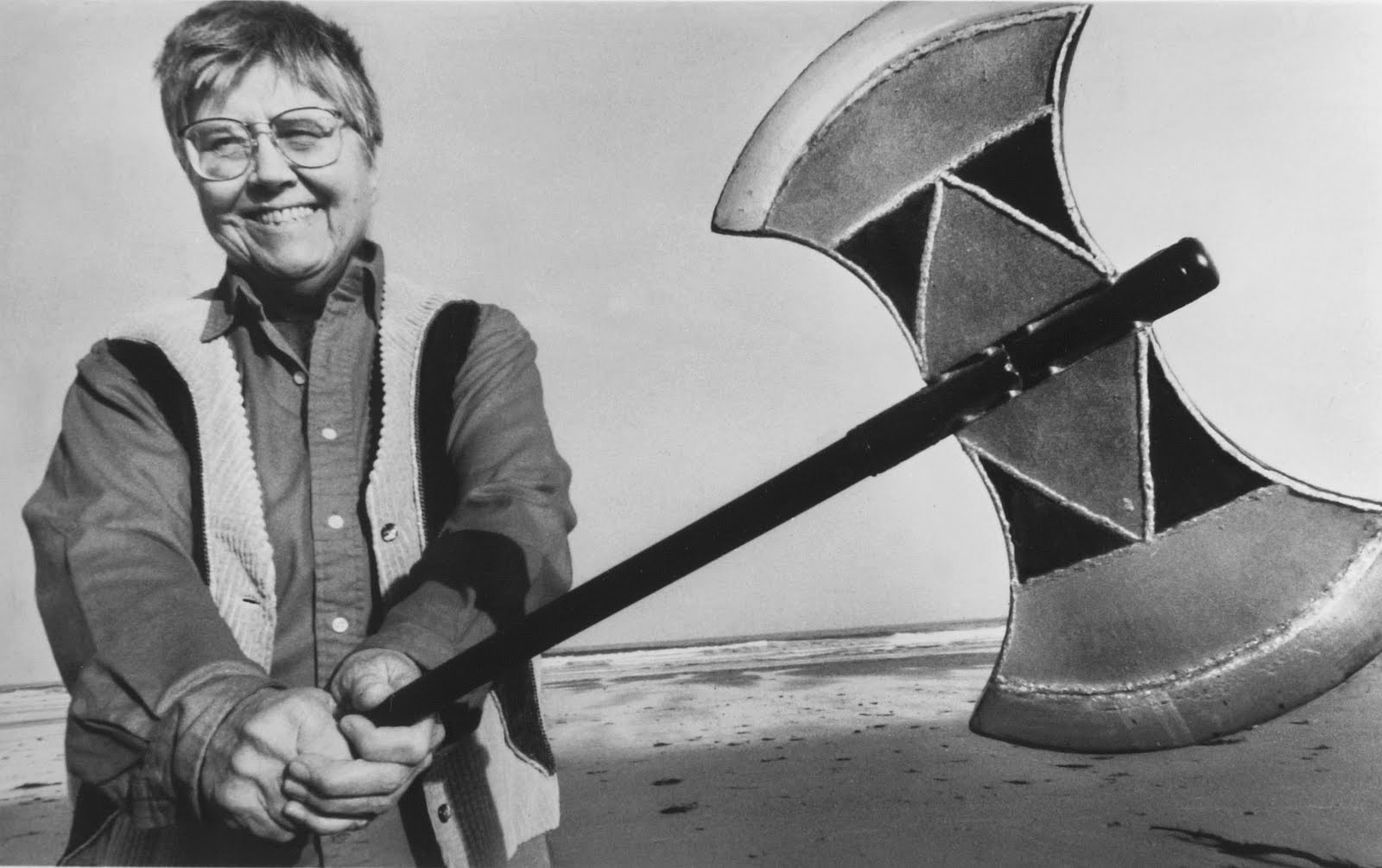
The old battle axe: A forgotten symbol of women's power

The late Mary Daly
There is an expression that isn't used much today.  In fact, I forgot about it until I saw this picture of one of my radical feminist SHEroes, Mary Daly, holding a labrys -- otherwise known as a battle axe -- in Ms. magazine.

The expression is "the old battle axe," and its meaning is somewhat derogatory.  It refers to a hard-headed, domineering woman.

For example, a man might make a reference to his wife by saying, "I'd better be getting home to the old battle axe."

And yet, the battle axe has a long history as a symbol of women's power.  According to lambda.org, the double-headed axe was used for harvesting as well as a weapon.  It was a favorite of early Amazons that populated what is now Kazakstan in Central Asia.  It was also used in the ancient town of Catal Huyuk, now Turkey, where the Earth goddess-worshiping people used it to clear land and "prospered without conflict for 1,500 years."

The labrys figured prominently in the motifs of the ancient Minoan society on the island of Crete. According to lamda.org, the Minoan society was "predominantly matriarchal" and its religion featured a bare-breasted snake goddess, believed to be a protector of women as well as a symbol of fertility and agriculture.

Dr. Christopher L.C.E. Witcombe, a professor of art history at Sweet Briar College in Virginia confirms, "There is plenty of archaeological evidence to indicate that women occupied an important if not dominant position within the practice of Minoan religion ... the predominance of goddesses ... is attested to by the dominant role played by priestesses  in religious ceremonies and the presence of women in ritual context ... Moreover, men are rarely seen in commanding positions, despite attempts to identify them in such positions ..."

The labrys was used for centuries throughout Europe until it was replaced by the sword as a weapon, and the plow as an agricultural tool.

Although not as prominent today, the lore of the battle axe made it a popular symbol of feminist and lesbian power in the 1970s.  This tiger's eye and silver necklace from my jewelry box could now be considered "retro" as well as historic and symbolic.